Rust solo players can drain a rich clan's loot by getting hired, earning trust and walking out with their sulfur
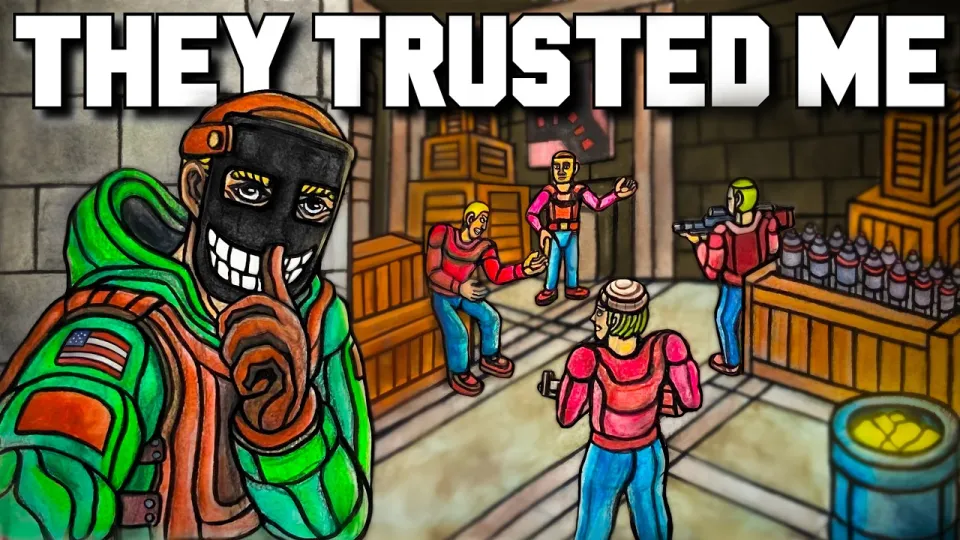
Video: I Secretly Drained Loot from the RICHEST CLAN - Rust (Movie)
You can order the same kind of articles for your own video to boost it on YouTube and Google. Just message the Telegram bot @sat_sit_bot. The bot writes and publishes the articles itself (with your YouTube video embedded) on popular topical websites (no ads). Free trial — 50 articles.
· based on the channel Welyn
Key takeaways
- A solo player joins the richest clan on the server as a hired hand instead of raiding it head-on.
- The scheme runs across six chapters of a feature-length Rust movie, from first contact to the final handoff.
- A second solo player, Memelicky, is recruited mid-story after running an almost identical con.
- The clan's own members hand over gear, scrap and materials while believing they are onboarding a new teammate.
- No raid cost: the loot leaves through the front door, so the victims keep restocking it.
Raiding the richest clan on a Rust server as a solo player usually ends with a broken base and an empty inventory. The alternative that actually works is to get hired by that clan, become the person they trust with the boxes, and move the loot out through the front door. That is the scheme Welyn builds over a feature-length Rust movie, and the Instagram page for his streams and clips is where the rest of his solo experiments live.
The idea is not new to survival games, but Rust's economy makes it unusually effective: clans stockpile sulfur, scrap, components and guns faster than they can use them, and every new member is a potential pair of hands. A solo who looks useful, works hard and never asks suspicious questions can end up closer to the vault than any rocket would ever get them.
Why draining a rich clan beats raiding it in Rust
A raid is a cost calculation, and against the biggest group on the server the math almost never favors one player. A clan base on a populated Rust server typically carries multiple layers of honeycomb, turrets, shotgun traps and enough online members to counter-raid within minutes. Even a successful solo raid leaves you with a fraction of the loot and a target on your back for the rest of the wipe.
Infiltration flips every one of those costs:
- No explosive budget. You spend time and conversation instead of sulfur and rockets.
- No base to defend. The loot leaves in small, deniable loads rather than one loud explosion.
- The clan keeps farming. Members continue to fill boxes you have access to, so the stockpile regenerates after every trip.
- Plausible cover. A member carrying materials around the compound is normal behavior; a stranger with a rocket launcher is not.
The trade-off is patience. You need to be genuinely useful, learn the base layout, find out who controls the boxes, and only then start moving items.
How the infiltration works step by step
Getting inside a clan in Rust is a social problem, not a mechanical one. The pattern that plays out in the movie follows a repeatable sequence any solo can copy:
- Make first contact in a low-stakes setting. A conversation at a monument, a trade, or helping during a fight puts your name in their heads without pressure.
- Offer labor, not loyalty. Farming runs, building repairs, door camping duty, ferrying scrap — clans are always short on hands and long on chores.
- Get invited into the compound. Once you are inside the walls, the base stops being a fortress and becomes a map of boxes, locks and codes.
- Learn the access rules. Who has the code to the main loot room, when the group sleeps, which boxes are considered communal and which are private.
- Move items in small loads. A stack of sulfur here, a gun there, deposited into a stash or a hidden drop point outside the walls.
- Stay useful until the end. The longer you keep farming and fighting alongside them, the less anyone audits the boxes.
The humor in the story comes from the fact that the clan never sees a theft — they see a hard-working new member who is always online and always helping.
Meeting Memelicky: the second solo running the same con
The best twist in the movie is that the scheme is not unique. Midway through, Welyn crosses paths with Memelicky, another solo who has been running an almost identical hustle, and the two compare notes instead of fighting. Memelicky's angle is the same insight: the richest groups on a Rust server are easiest to rob from the inside, and the same clan had raided him repeatedly without ever recognizing him afterward.
The partnership changes the scale of the operation. Two players can cover more of the day, split farming duties, pass information about who is online, and keep two separate streams of loot flowing out of the compound. The handshake between the two solos is the moment the story turns from a personal grudge into a coordinated heist, and it is the part viewers remember most.
Loot, trust and the economics of a Rust wipe
Rust's progression is built on scarcity that clans erase by sheer numbers. A large group can farm sulfur nodes, run monuments and hold cargo ship spawns around the clock, which means their boxes fill with items a solo would need a full wipe to collect. Every stack that leaves their base is value transferred directly from the group's advantage to yours.
The economics also explain why the con survives contact with the victims. Clans measure their health in upkeep, weapons and raid readiness, not in exact box counts. A missing stack of sulfur is invisible until the next raid planning session, and by then the deficit has been refilled by farming. The real risk is not suspicion but routine: a member who suddenly stops contributing gets noticed far faster than one who quietly takes a little extra.
Typical viewer questions about the Rust clan heist
Most of the debate around this style of play comes down to three doubts, and each has a practical answer:
- Isn't this just having a job? A clan member gets gear and a share of group loot; an infiltrator gets access to everything and a one-way exit. The difference is who ends up holding the stockpile at the end of the wipe.
- What happens when you get caught? Nothing catastrophic — you lose a kit and a reputation on one server. The loot already moved out stays out, which is why small, frequent loads matter more than one big grab.
- Does it work against small groups? Less well. Three or four players know each other's inventories by heart; the strategy scales with group size and anonymity.
All the links from the video
- Welyn on Instagram — stream schedule, clips and behind-the-scenes posts
- Thumbnail art by reidsintoart
- Welyn live on Twitch
- Welyn clips channel on Instagram
- Welyn on X
What makes this Rust movie worth watching
This is a solo survival story told through social engineering rather than explosives, and it works because every step is reproducible on a live server. Welyn structures the run as a six-chapter movie — first contact, embedding in the clan, the meeting with Memelicky, the coordinated drain, the fallout and the handshake — so the con reads like a heist film instead of a highlight reel. The clan's own generosity becomes the engine of its loss, and the second solo running the same trick proves the method is a pattern, not a fluke. If you want more of this kind of long-form Rust storytelling, follow Welyn on Instagram and catch the streams where these wipes are actually played out.
Source: I Secretly Drained Loot from the RICHEST CLAN - Rust (Movie) · Markdown version
Questions & answers
Can a solo player really rob the biggest clan on a Rust server?
Yes, if the clan recruits. Large groups constantly need farmers and builders, and a helpful new member gets access to communal boxes within days. The limit is patience: you move small loads over many sessions instead of one big raid, and you keep contributing so nobody audits the stockpile.
Do you need explosives or a raid base for this strategy?
No. The whole point is avoiding the explosive cost. Loot leaves through doors you are allowed to open, usually into a stash or a small hidden base outside the compound. A raid against a top clan would cost far more sulfur than a solo can farm in a reasonable time.
What happens if the clan catches you taking loot?
You lose your kit and your access, but the items already moved out stay with you. That is why frequent small transfers beat one large grab — the downside is capped at whatever you are carrying at that moment.
Who is Memelicky in the video?
Memelicky is a second solo player running an almost identical infiltration against the same clan, which had raided him multiple times without remembering him. The two compare methods and team up, which lets them cover more hours and split the farming work.